
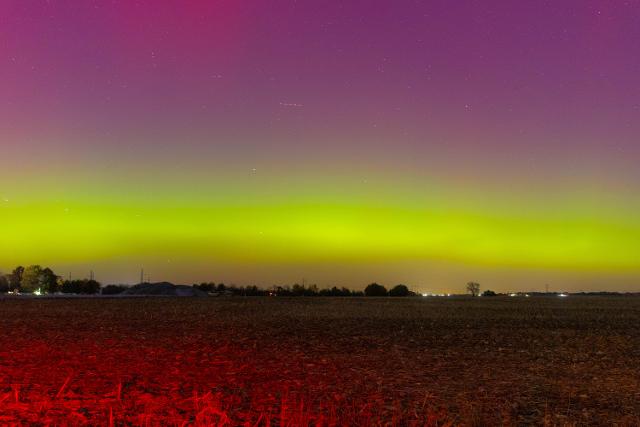
 ALTON - The NOAA Space Weather Prediction Center has issued a severe Geomagnetic Storm Watch through Wednesday, Nov. 12, 2025, indicating heightened geomagnetic activity that may make the Aurora Borealis (Northern Lights) visible across parts of the United States, including the St. Louis region.
The Northern Lights Phenomenon occurs when charged particles from the sun collide with molecules in Earth’s atmosphere, producing light displays typically seen closer to the poles.
Get The Latest News!
Don't miss our top stories and need-to-know news everyday in your inbox.
An Earth-directed coronal mass ejection is currently sparking a moderate geomagnetic storm, which NOAA projects could create auroral activity visible as far south as the St. Louis and Metro East Illinois region.
The National Weather Service in St. Louis noted on Wednesday, Nov. 12, 2025, that clear skies are expected this evening, improving the chances of observation.
“You are likely to have better luck with a cell phone looking north and well away from the bright lights of the city than with the naked eye,” St. Louis weather forecasters said on Tuesday.
NOAA’s aurora forecast uses the OVATION model, which maps the expected intensity and location of the aurora based on geomagnetic activity between 6 p.m. and 6 a.m. Central Time. The forecast indicates the aurora appears as a green oval centered on Earth’s magnetic pole, turning red when the activity is more intense. While the aurora is typically visible after sunset or before sunrise, daylight hours prevent visibility.
Timing the aurora remains uncertain, as NOAA predicts the geomagnetic storm will peak during daylight hours on Wednesday, potentially limiting visibility in St. Louis. However, auroras can occur hours before the predicted peak. Clear skies and minimal light pollution will be critical for viewing.
Residents interested in observing the Northern Lights are encouraged to find locations away from city lights, look toward the northern horizon after sunset, and use cell phone cameras, which can sometimes detect the aurora more easily than the naked eye.
In addition to the aurora forecast, the St. Louis area will experience warming temperatures over the next several days, with highs rising from the mid-60s on Wednesday to the upper 70s by Saturday and 60s on Sunday. No rain is expected until early next week.