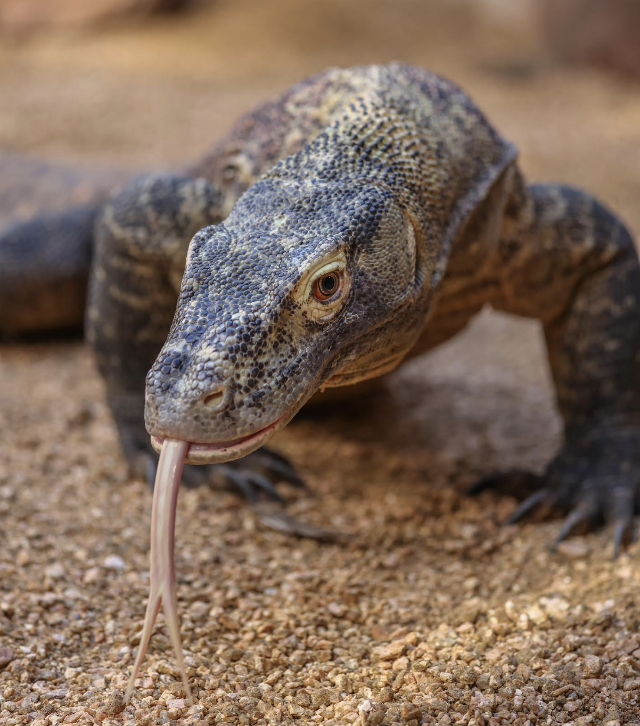
 ST. LOUIS - Saint Louis Zoo will soon debut 6-year-old male Komodo dragon Charlie, the first resident of the Zoo’s brand new Komodo dragon habitat at the Charles H. Hoessle Herpetarium. Charlie will be the first of his species to live at the Zoo in more than 12 years.
Get The Latest News!
Don't miss our top stories and need-to-know news everyday in your inbox.
The young Komodo dragon arrived at the Zoo on Sept. 20, 2025, from Bronx Zoo in New York, an Association of Zoos and Aquariums (AZA)-accredited institution. The Herpetarium underwent special renovations to prepare for his arrival, including the construction of a new solarium specially designed for the 6-foot-long reptile. Charlie is named after Saint Louis Zoo Director Emeritus Charles H. Hoessle, namesake of the Herpetarium.
The new Komodo dragon solarium will debut to the public during evening hours 5-8:30 p.m. Oct. 16-19 as part of the ticketed evening event, Boo at the Zoo presented by SSM Health Cardinal Glennon. Beginning at 9 a.m. on Monday, Oct. 20, Charlie can be seen during regular Zoo hours and during Boo at the Zoo in the evenings.
“Our team has been eagerly preparing for Charlie’s arrival, and we can’t wait for guests to discover all the things that make Komodo dragons one-of-a-kind,” said Justin Elden, Curator of Herpetology and Aquatics, Saint Louis Zoo. “It’s a privilege to have this unique and endangered species in our care.”
The Komodo Solarium
Charlie is the sixth Komodo dragon to make a home at the Saint Louis Zoo. To prepare for his arrival, three existing reptile habitats at the Herpetarium were merged and redesigned according to evolving animal care standards. The new habitat is uniquely suited to Charlie’s growth and enrichment needs.
To protect the Herpetarium’s historic integrity, the Zoo used original steel framing to construct the new solarium. The glass enclosed room includes UV-transmissible ceiling panels which allow essential UVA and UVB light to pass through year-round — a vital source of warmth for cold-blooded Komodo dragons that cannot regulate their own body temperatures.
The solarium is equipped with five basking spots including heated rocks, UV lamps and other areas for Charlie to soak up the sun. These basking spots are regulated by automatic timers that switch warming elements on and off throughout the day, encouraging Charlie to move about his habitat and promote exercise. The solarium is modeled after a dry forest climate where Komodo dragons would naturally live in the wild.
Komodo Dragons and Komodo Conservation
Komodo dragons (Varanus komodoensis) are the largest species of lizard, weighing up to 300 pounds at full size. In the wild, they are found only on five islands in Indonesia and may grow as long as 10 feet. With powerful salivary proteins and sharp teeth, Komodo dragons are apex predators capable of taking down prey much larger than themselves.
The species typically lives a solitary life and has been known to display cannibalistic behaviors. Remarkably, female Komodo dragons can reproduce asexually through a process called parthenogenesis.
Although Komodos can live 20 to 30 years in human care, many in the wild never survive their first year. Habitat loss, poaching of their primary food source (deer) and the impacts of climate change have all contributed to their endangered status.
Charlie came to Saint Louis Zoo through coordinated efforts under the AZA Komodo Dragon Species Survival Plan (SSP), which works to ensure a healthy and genetically diverse population of Komodo dragons in the U.S. The Komodo Dragon SSP, along with initiatives such as Komodo National Park and strict Indonesian wildlife laws, are critical to safeguarding the future of this remarkable species.
About Saint Louis Zoo
Home to 12,000 animals, representing nearly 450 species, the Saint Louis Zoo is recognized worldwide for its innovative approaches to animal care and management, wildlife conservation, research and education. One of the few free zoos in the nation, the Saint Louis Zoo is the most visited attraction in the region. Accredited by the Association of Zoos and Aquariums (AZA), the Saint Louis Zoo is part of an elite group of institutions that meet the highest standards in animal care as well as provide fun, safe and educational family experiences. The Saint Louis Zoo and other AZA-accredited institutions collectively dedicate millions of dollars annually to support scientific research, conservation and education programs. For more information, visit stlzoo.org.